
Is Tasks.Bot Good for Real Time Trigger Automation Software?
Your team misses deadlines because reminders arrive after the work is already late. Real time trigger automation fixes that gap by firing tasks, approvals, and alerts the moment something changes, not the next morning. Tasks.Bot is betting WhatsApp can be that trigger layer.
This article explains how Tasks.Bot handles real time triggers, from voice note task creation to AI-driven deadline reminders and GPS check-ins. You will also see its pricing, beta status, and who actually benefits from trigger-based automation before you commit.
What Is Tasks.Bot?
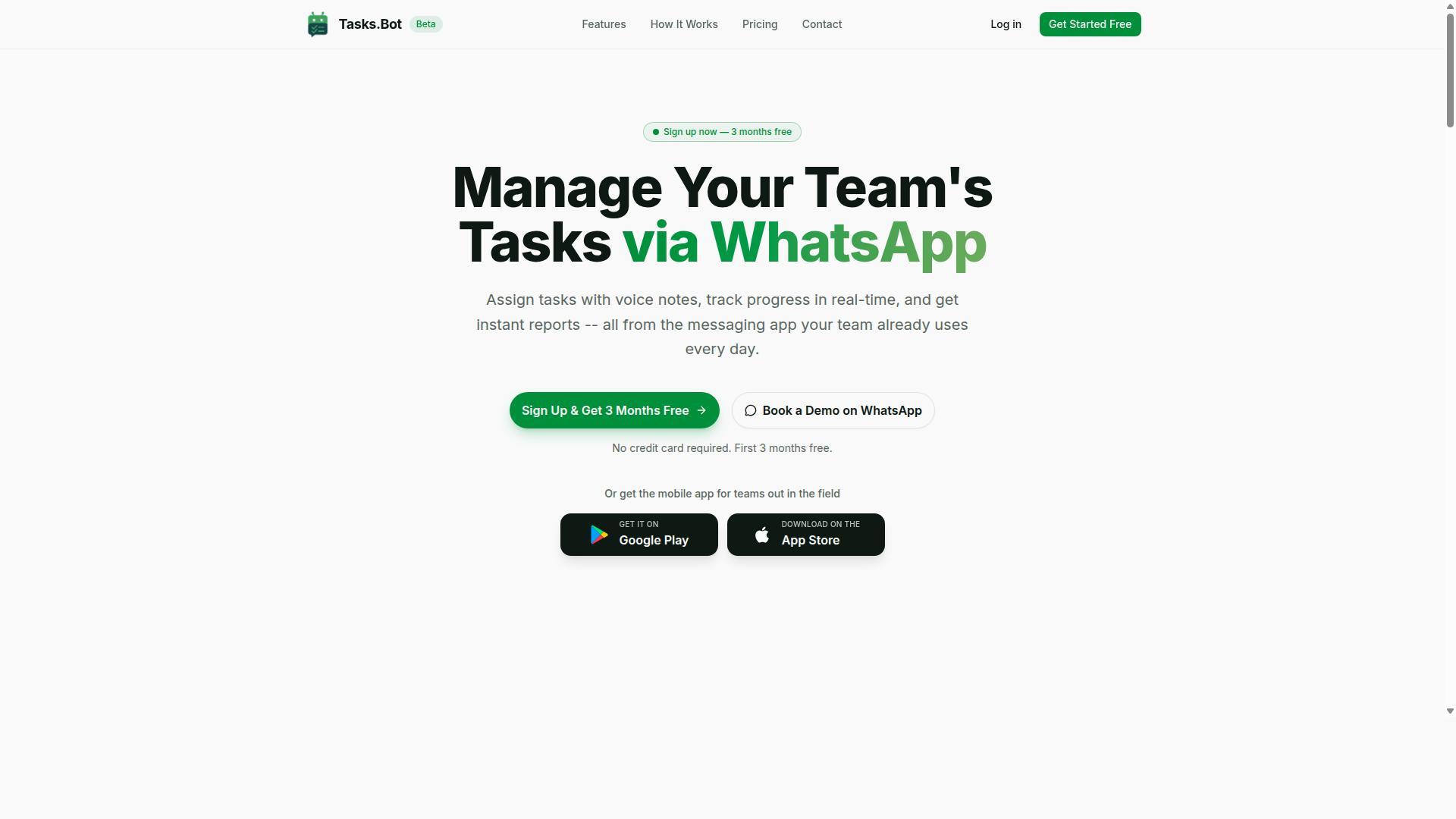
Tasks.Bot is a task management platform that operates entirely within WhatsApp, enabling teams to assign tasks, track progress, and receive reports without leaving the messaging app. It removes the friction of adopting yet another tool, because there is no new app or account to set up before work begins.
Delivered as a SaaS product, Tasks.Bot also offers a mobile app for field teams. The service is currently in beta and includes a free trial period, giving teams room to test how it fits their daily operations.
Who Tasks.Bot Serves and How It Works via WhatsApp
Tasks.Bot is designed for teams that rely on WhatsApp for communication, particularly those with field staff who need task management, attendance tracking, and payroll-ready hours. For these groups, the messaging app is already the center of coordination, so adding a separate system often creates more work than it removes.
Because everything runs through WhatsApp, adoption is straightforward. Users interact in the same chat thread they already use, which keeps the learning curve low and keeps remote or mobile workers connected without extra training.
The mechanics stay simple in practice. A manager can create a task, assign it to a team member, and let reminders keep it visible. The assigned person submits updates as the work progresses, all inside the conversation.
- Assigning a delivery task to a driver and tracking completion status
- Recording attendance for on-site or dispersed field staff
- Capturing payroll-ready hours from the same updates
- Sending reminders so nothing slips through the chat
No new app installation is required to get started, and a mobile app complements the experience for teams that want it. The site notes that hundreds of teams already use the service, which suggests the WhatsApp-first approach fits how many field operations actually run.
For real-time trigger automation, this matters because the trigger is a message rather than a form submission or dashboard click. When the action happens in the same place the team already talks, updates arrive closer to when the work happens, which supports more timely, event-driven coordination.
Is Tasks.Bot Good for Real Time Trigger Automation?
Tasks.Bot leverages WhatsApp's real-time messaging infrastructure to deliver trigger-based automation for task management, making it a viable option for teams seeking immediate responsiveness.
Real-time trigger automation means software reacts the moment something happens, rather than waiting for a scheduled check. In Tasks.Bot's case, messages themselves act as triggers, so a single chat entry can create a task, update a status, or fire a notification.
This event-driven approach suits teams that already run their work through WhatsApp. The sections below examine specific automations and the mechanics behind them.
Automations, Approvals, and Smart Deadline Reminders
Tasks.Bot includes built-in automation features such as approval workflows and smart deadline reminders that trigger based on task status or due dates. When a task is marked complete, an approval request can be sent automatically to the right person for sign-off.
Deadlines work the same way. A reminder can fire a set period before a due date, and if the task is still open past that point, conditional logic can escalate it to a manager or reassign it. These rules are configurable without coding, which keeps setup within reach of non-technical teams.
Other practical triggers include:
- Auto-assigning a task when a message contains a specific keyword
- Sending a reminder 24 hours before a due date
- Escalating an overdue item to a supervisor
- Requesting approval before a task is closed out
Because everything runs inside WhatsApp, these triggers cut down on manual follow-ups. Team members do not need to open a separate dashboard or chase updates by email, since the notification arrives in the same thread where the work was discussed.
This is a form of business process automation that stays lightweight. It does not require robotic process automation or a separate no-code platform to configure, and the trigger-based actions live where conversations already happen.
How Real Time Triggers Work Inside WhatsApp
Tasks.Bot uses WhatsApp's API to listen for incoming messages and events, converting them into triggers for task automation. Rather than polling for changes on a timer, the system relies on webhook integration: WhatsApp pushes a notification the moment a message arrives.
The flow is straightforward. A user sends a message, the webhook fires, Tasks.Bot processes the content, and the relevant action runs, whether that is task creation, a status update, or a notification. Because the platform uses AI to understand user intent, a plain message can become a structured task without manual data entry.
This contrasts with polling versus webhooks in a meaningful way. Polling checks for new data at fixed intervals, which introduces delay, while an event listener reacts immediately. The result is lower latency and faster task assignment across a team.
Under the hood, systems at scale often rely on message queues and event-driven architecture to handle bursts of activity. That pattern supports real-time processing without overwhelming the application, which matters for reliability and uptime as usage grows.
For teams, the practical payoff is simple: updates land in near real time, and the gap between a request and a recorded task shrinks to seconds. Tasks.Bot also offers Android and iOS apps with push notifications, so alerts reach users even away from the chat window.
Key Features That Support Trigger-Based Automation
Tasks.Bot offers several features that enhance trigger-based automation, from voice note task creation to GPS tracking, all accessible within WhatsApp. Each capability acts as an input or event that can kick off a downstream action, whether that means creating a task, updating a status, or notifying a manager.
The core building blocks include voice notes, AI natural language processing, a live day tracker, GPS tasks on a map, and face-verified attendance. Together they form a practical event-driven layer for teams that work outside a desk.
Because everything runs inside WhatsApp, no new app install or account setup is required. The sections below break down how each feature feeds trigger-based actions.
Voice Note Task Creation and AI Natural Language Input
Tasks.Bot uses AI to interpret voice notes and natural language text, allowing users to create tasks by simply speaking or typing a message in WhatsApp. Instead of filling out a form, a team member can send a short voice note and let the system do the parsing.
The AI component reads the message and pulls out the details that matter: who the task belongs to, when it is due, and how urgent it is. A phrase like "Remind John to submit the report by Friday" becomes a task with a clear assignee and deadline, without any manual entry.
This matters for real-time trigger automation because the trigger is a natural message, not a structured command. There is no rigid syntax to learn and no separate interface to open. Reducing friction at the point of capture means tasks get logged while they are still fresh, rather than hours later.
For teams weighing automation software, this is a genuine differentiator. Many tools expect users to adapt to the system. Here, the system adapts to how people already communicate. That lowers the barrier for adoption and keeps task entry fast, which in turn keeps the rest of the workflow moving.
It also fits a no-code platform philosophy. Anyone who can send a WhatsApp message can create a task, so the automation chain starts with a tool the whole team already knows how to use.
Live Day Tracker, GPS Tasks on a Map, and Face-Verified Attendance
Tasks.Bot includes a live day tracker, GPS-enabled tasks on a map, and face-verified attendance, providing real-time visibility into field operations. Each one produces events that can feed further automation.
The live day tracker shows task progress as the day unfolds. When a status changes, that update can trigger a notification or a follow-up action, so managers see movement without chasing updates.
GPS tasks on a map let work be tied to a location. A task can be associated with a site, and arrival or completion on-site becomes a meaningful event in the workflow.
- Face-verified attendance uses facial recognition to clock staff in and out
- Each clock event feeds attendance records and payroll calculations
- Location and completion events can notify a manager automatically
Taken together, these features generate the signals that trigger-based actions depend on. A completed on-site task can alert a supervisor. A verified clock-in can update hours. The result is a connected flow rather than a set of disconnected records.
Pricing and Plans
Tasks.Bot offers a single 'Full Access' plan with all features included, priced at ₹200 per member per month or ₹1,200 per year per member. There are no tiers to compare, no feature gates, and no upsells. Every capability the platform offers sits inside that one plan.
Pricing is shown in Indian Rupees (₹) and US Dollars ($). A currency selector on the site lets buyers choose between the two, so the amount you see depends on the option you pick. Verifying the displayed currency before checkout is a sensible step for anyone comparing budgets across regions.
The annual option carries a clear advantage. At ₹1,200 per year per member, a subscriber pays the equivalent of six months and gets twelve, a savings of 50% compared with paying monthly. In absolute terms, that works out to ₹1,200 saved per member each year.
Because billing is per member, cost scales directly with team size. A small group pays proportionally less than a large department, and adding or removing seats adjusts the total without renegotiating a contract. That structure suits teams whose headcount shifts during project cycles.
What the Full Access plan includes
The plan bundles every feature the platform offers rather than splitting them across tiers. For a buyer evaluating real-time trigger automation, that removes a common source of friction: the worry that event listeners, conditional logic, or webhook integration sit behind a higher price band.
New users also receive 3 months free, with no credit card required, and can cancel anytime. That trial window gives a team enough runway to test trigger-based actions against its own workflows before committing budget.
Cost-effectiveness across team sizes
Per-member pricing makes the math straightforward. A five-person team on the annual plan pays ₹6,000 per year in total, while a twenty-person team pays ₹24,000. Doubling headcount doubles cost, with no volume penalty and no hidden platform fee.
| Team size | Monthly (₹200/member) | Annual (₹1,200/member) | Annual saving |
|---|---|---|---|
| 5 members | ₹1,000 per month | ₹6,000 per year | ₹6,000 |
| 10 members | ₹2,000 per month | ₹12,000 per year | ₹12,000 |
| 25 members | ₹5,000 per month | ₹30,000 per year | ₹30,000 |
Compared with automation platforms that charge by task volume or by workflow count, a flat per-member rate is easier to forecast. Budgets stay predictable even when trigger frequency rises during busy periods, which matters for teams running high-throughput event-driven architecture.
Beta status and refund policy
Tasks.Bot is currently in beta. Buyers should read pricing and terms as they stand today, since a product at this stage can revise its plan structure as it develops. The 3-month free window reduces that risk considerably, letting teams evaluate the service before any payment is made.
A refund policy is in place for paid subscriptions. Combined with the ability to cancel anytime, the commercial terms give teams a low-commitment path to test whether Tasks.Bot fits their real-time trigger automation needs.
For a team weighing cost against capability, the structure is simple: one plan, all features, per-member pricing, and a free trial long enough to judge fit. That transparency is a reasonable signal of good faith for a product still in beta.
Trust Signals and Current Status
Tasks.Bot is currently in beta, with hundreds of teams already using it, and offers a refund policy as a trust signal. That combination tells a clear story: the product is real, it is in active use, and the company stands behind it with a money-back option for anyone who tries it.
Beta status is worth understanding before signing up. It means the platform is still being actively developed, so features may change and occasional rough edges are possible. For teams evaluating real-time trigger automation, that is a trade-off to weigh rather than a red flag.
What beta does not mean is untested. Hundreds of teams already rely on Tasks.Bot for workflow automation, which suggests the core trigger-based actions hold up under everyday use. Still, anyone with strict uptime requirements should treat the current stage as a reason to test carefully before depending on it for mission-critical processes.
Several signals point to a company that plans to be around for the long haul:
- Refund policy listed in the footer, giving buyers a fallback if the tool does not fit their needs
- Book a Demo on WhatsApp, a direct way to speak with the team before committing
- Global availability, since the service can be accessed through WhatsApp from anywhere
- Copyright year 2026, a forward-looking marker that the site is actively maintained
The demo option is a practical trust signal on its own. Instead of forcing a self-serve signup, Tasks.Bot lets prospective users ask questions directly, which is useful when you want to check whether its API triggers, webhook integration, and conditional logic fit your event-driven architecture.
Being transparent about the beta label matters here. Real-time processing demands reliability, and no honest vendor in beta should promise guaranteed uptime or fixed latency figures. What Tasks.Bot does offer is a working product, an active user base, and a refund path if expectations are not met.
The verdict is straightforward. Tasks.Bot is a legitimate, actively developed option for real-time trigger automation, and its refund policy, WhatsApp demo access, and global reach are genuine trust signals. Just go in with realistic expectations about beta-stage stability and test your key triggers before rolling them out widely.
Who Should Use Tasks.Bot for Automation
Tasks.Bot is ideal for teams that communicate via WhatsApp and need to automate task assignment, tracking, and reporting, especially those with field staff. Instead of asking workers to adopt yet another app, it plugs into the messaging tool they already open every day.
That single design choice shapes everything about who benefits most from this kind of real-time trigger automation. When the trigger is a message rather than a login, adoption stops being a training problem and becomes a non-issue.
Small and medium teams get the clearest value. They rarely have the budget for a dedicated operations platform, and they rarely have the patience for a long rollout. A SaaS tool that lives inside WhatsApp removes both obstacles at once.
The site notes that hundreds of teams already use the service, which suggests the fit is broad rather than niche. Field-heavy operations tend to see the fastest payoff.
Certain groups stand out as natural fits:
- Field service businesses that dispatch workers to different sites each day and need proof of attendance
- Construction crews where supervisors assign jobs verbally and need a written record
- Delivery teams that track routes, handoffs, and completion in near real time
- Sales teams working remotely who need follow-ups scheduled and logged without opening a CRM
- Remote teams spread across locations that already run their day on WhatsApp
For each of these, the appeal is the same: task assignment, attendance tracking, and payroll-ready hours flow from conversations that were happening anyway.
Not every organization should adopt this model. Teams that do not use WhatsApp as a primary communication channel would gain little, since the entire value rests on meeting workers where they already are.
Organizations needing complex on-premise deployment or deep custom event-driven architecture may also find a WhatsApp-first SaaS tool too constrained. Those cases usually call for heavier platforms with dedicated infrastructure.
If your team lives in WhatsApp and manages people in the field, the fit is strong. If it does not, look elsewhere.
Final Verdict
Tasks.Bot offers a compelling solution for WhatsApp-centric teams seeking real-time trigger automation without the complexity of traditional automation platforms. Its combination of AI-powered task creation, real-time triggers, and direct WhatsApp integration makes it a practical choice for organizations that already run their daily communication through the messaging app.
Unlike heavyweight tools built around event-driven architecture with message queues or Kafka pipelines, Tasks.Bot keeps things straightforward. It targets teams that want trigger-based actions inside a familiar interface rather than a full engineering project. That focus is both its greatest strength and its clearest limitation.
Below is a balanced look at where Tasks.Bot delivers value and where buyers should set expectations before committing.
- Strengths: seamless WhatsApp integration, AI-powered task creation, real-time triggers, and affordable pricing
- Weaknesses: beta status, limited to the WhatsApp ecosystem, and no on-premise option
The strengths matter most for teams that live in WhatsApp. Real-time triggers mean actions fire as events happen, not on a delayed polling cycle. That is the core promise of real-time processing, and Tasks.Bot delivers it inside the channel where work already gets discussed.
AI-powered task creation lowers the barrier further. Users do not need to master conditional logic or webhook integration concepts to get value. This is closer to a no-code platform experience than to robotic process automation or RPA, which typically demands technical setup and ongoing maintenance.
Affordable pricing rounds out the case. For small and mid-sized teams, cost predictability often decides whether workflow automation gets adopted at all. Tasks.Bot keeps that threshold low.
The weaknesses are real and worth stating plainly. Beta status means the product is still maturing, so buyers should expect the pace of change that comes with an early-stage SaaS offering. Teams with strict change-management policies may want to factor that in.
Being limited to the WhatsApp ecosystem is the biggest constraint. Organizations needing broad integration capabilities across dozens of external systems, or those comparing against Zapier, Make, n8n, Microsoft Power Automate, or IFTTT for multi-channel orchestration, will find Tasks.Bot narrower by design. It is not trying to be a universal automation hub.
The absence of an on-premise deployment option also rules it out for businesses with data residency requirements or security policies that mandate self-hosted infrastructure. Tasks.Bot is cloud automation only.
Weighing both sides, the verdict is clear. Tasks.Bot is a good fit for teams already on WhatsApp that need simple, reliable trigger-based actions without a steep learning curve. It is not the right tool for enterprises seeking on-premise deployment, wide integration coverage, or a fully mature platform with a long track record.
For its intended audience, the trade-offs are reasonable. Simplicity, real-time responsiveness, and low cost often outweigh the missing breadth, especially when the alternative is no automation at all. Teams that match the profile should find genuine day-to-day value.
For more information or to get started, contact Tasks.Bot at [email protected] or +91 97143 42522.
Frequently Asked Questions
Is Tasks.Bot actually built for real-time trigger automation, or is it just a task list?
Tasks.Bot is a task management platform that runs inside WhatsApp, and it includes automations alongside features like automatic task assignment and smart deadline reminders. That means triggers such as a task being created, assigned, or coming due can kick off actions without your team switching apps. It's designed for real-time coordination, not just static to-do lists.
Do my team members need to install anything or create new accounts to use it?
No. Tasks.Bot operates entirely within WhatsApp, so team members don't need to install anything or create new accounts to receive tasks, get reminders, or submit updates. There's also a mobile app for field teams who need extras like tasks on a map and attendance tracking. This keeps adoption friction low, which matters when you're rolling out automation across a team.
How do tasks get created and triggered in real time?
Tasks.Bot uses AI to understand natural language and voice notes, so you can create a task by simply sending a message or voice note in WhatsApp. From there, automatic task assignment and smart deadline reminders handle the routing and follow-ups. Approvals and automations let you chain actions together so the right people are notified at the right moment.
Can I get reports and visibility into what's happening as it happens?
Yes. Tasks.Bot provides instant reports and live day tracking, so you can see progress without chasing people for updates. Tasks on a map give field-based teams location context, and face-verified attendance supports payroll-ready hours. Everything surfaces within WhatsApp, so real-time status is always a message away.
How much does Tasks.Bot cost, and is there a free trial?
Tasks.Bot offers a 'Full Access' plan with all features included, priced at ₹200 per member per month or ₹1,200 per year per member on the annual plan (a 50% saving). Pricing is available in both Indian Rupees and US Dollars. The service is currently in beta, and the website includes a refund policy in the footer, so check current terms before subscribing.
Is Tasks.Bot available in my country, and how do I get started?
Tasks.Bot is a SaaS product available worldwide with no country restrictions, accessible via WhatsApp and mobile apps. You can book a demo directly on WhatsApp from the website. For questions, reach the team at [email protected] or +91 97143 42522.
Recommended Resources: